

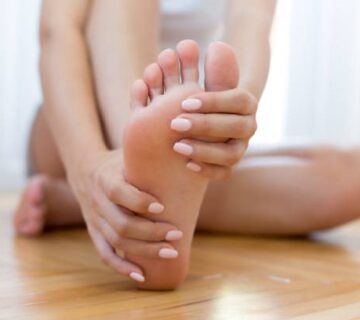
Our feet are key when it comes to supporting our musculoskeletal system and are often overlooked when it comes to lower back and limb discomfort. They house a quarter of the body’s bones and contain one of the most concentrated areas of sensory nerve endings per square inch in our tissues. They perform a phenomenal job every moment that we weight-bear and can withstand tremendous forces in a multitude of directions whilst simultaneously co-managing our balance system from the ground up.
With many of us taking up running during the Covid-19 lockdown, or on the opposite end of the spectrum becoming less active, our feet can become an annoying source of aches and pains.
For those of us who have been less active, restricted to one room perhaps or unable to maintain the daily level of movement associated with going to work and socialising, our feet and ankles may become stiffer than normal, with the small internal muscles and joints becoming restricted and ultimately weaker. Using simple stretches and mobilisations can greatly help to ease joint and muscle tightness and are easy to do whilst sat at a desk or on the sofa.
Here are a few simple exercises to try, but remember if you have an injury or your symptoms are of concern or worsening, it is best to consult your GP or Chiropractor prior to attempting these:
- Rotating the foot and ankle each way 10 times or writing the alphabet with each foot is a great way to get all the joints moving.
- Pointing the toes of the foot down, up, inwards, and outwards and holding each position for 5 seconds (The North/South/East/West stretch) is a great way to stretch out the connective tissues in the foot.
- Placing a small bowl on the ground with marbles / stones / bottle tops scattered about and picking them up with your toes to place in the bowl for 2-4 minutes is perfect to mobilise the small internal muscles of the feet.
- Roll the sole of the foot over a golf or tennis ball to ease tightness, making sure to only roll over the soft tissues, for up to one minute at a time.
Running is a fantastic way to increase activity, manage our weight and improve our cardio. However, to newer runners or those picking it up again after a long absence our feet may take a while to adapt to the increasing loads, and to build up the endurance necessary to prevent injury. A few helpful hints here are:
- Starting on shorter runs or intervals between walking and running – the NHS Couch to 5km app is a fantastic resource to consider here.
- Varying our routes and considering mixing road with gravel / off-road running to reduce the potential for repetitive-type strains.
- Lower limb exercises such as calf-raises and multi-directional static lunges are beneficial to strengthen our muscles and support our joints – preventing other issues higher up such as knee or hip pain.
- Footwear may also play a big role in foot pain. Ditching the heels and flip flops allow our foot biomechanics to work better, so make sure you use supportive footwear suitable for the activity at hand.
- Running shoes are designed now for different foot-types so it is important to select the best shoe structurally for you.
Of course – walking is the best exercise for our feet, so try to get a couple of walks in a day no matter how short and aim to keep those steps up with lots of microbreaks from the desk, even if you cannot hit the golden ‘10 000’!
Carmen Morgan DC is an Associate at the Romsey Chiropractic Clinic and is available to discuss your lower limb / foot and ankle concerns.


No comment